Age Verification Compliance for Businesses: A Practical Guide to ID Verification and Risk Mitigation
Businesses selling age-restricted products face substantial operational challenges and regulatory oversight. Properly verifying customer age is a fundamental legal obligation. When employees fail to perform checks, they expose the business to severe administrative penalties and potential closure. Implementing a standard verification protocol ensures that front-line staff can confidently evaluate identification documents and refuse service when necessary. In states like California and New York, enforcement agencies conduct regular undercover operations specifically targeting businesses that accept a fake ID or counterfeit ID at the point of sale — making rigorous verification an operational necessity, not just a legal formality.
The Legal Framework and Consequences of Non-Compliance
Under national and local regulations, businesses trading in age-restricted products — such as alcohol, tobacco, and adult entertainment — must ensure minors do not obtain access. Compliance is monitored closely through undercover checks conducted by law enforcement or licensing inspectors. If a business is found to have sold restricted items to an underage person — often because staff failed to detect a fake ID presented at checkout — the consequences are immediate. Penalties typically escalate with subsequent offenses. Initial infractions may result in warnings or administrative fines. However, repeated failures can lead to the suspension or permanent revocation of the business's retail licenses. Individual clerks can also face personal prosecution, resulting in misdemeanor charges and substantial fines. Public disclosure of compliance failures damages business reputation, while failure to enforce compliance increases civil liability if accidents occur.
The Step-by-Step Age Verification Process
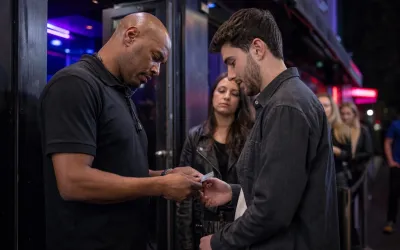
A superficial glance at an identification card is insufficient to satisfy compliance requirements. Front-line staff must follow a methodical age verification process for every transaction involving age-restricted goods. This process begins with requesting physical identification and taking possession of the card. Handling the document is critical for checking physical properties and ensuring it is genuine. Once the document is in hand, the employee must perform key checks. First, calculate the customer's age using the birth date on the card, comparing it against a pre-calculated sign near the register. Second, compare the photograph on the card with the customer's physical appearance, focusing on stable facial structures like the jawline and eye distance. Third, verify the physical description matches. Fourth, check the expiration date, as expired IDs are legally invalid. Fifth, look for signs of physical alteration, such as split lamination, uneven edges, or inconsistent printing — common characteristics of a counterfeit ID or fake driver's license. If the card fails any checks, the employee must refuse the sale and document the transaction.
Physical Document Inspection vs. Common Discrepancies
Identifying altered documents requires staff to understand official ID design elements. High-quality government cards contain complex security features that are difficult to reproduce. Understanding these features enables staff to distinguish between valid and altered documents. The following table outlines the physical features staff should check and common signs of fraud:
| Document Feature | Standard Check Procedure | Common Indicator of Alteration or Fraud |
|---|---|---|
| Card Material | Feel the thickness of the card and flex it gently. Government IDs use durable polycarbonate or composite plastic. | Excessive flimsiness, split edges, or peeling layers indicating homemade lamination. |
| Tactile Features | Run a finger over the surface of the card to check for raised lettering on name and birth date fields. | A completely smooth card surface or flat ink that lacks physical texture or engraving depth. |
| Holograms | Tilt the card under a light source to observe how the holographic overlays react to changing angles. | Static, dull, or poorly aligned patterns printed directly onto the surface that do not shift. |
| Microprint | Examine the background design and borders for fine, continuous lines visible under close inspection. | Blurry print, jagged borders, or broken lines caused by consumer-grade scanning and printing. |
| Ghost Images | Locate the smaller, semi-transparent replica photo and verify it matches the primary image and contains official overlays. | Mismatched facial features, or a secondary image that is solid, opaque, or poorly aligned — characteristics frequently found on scannable fake IDs produced with desktop printers. |
Establishing Staff Training and Refusal Documentation Protocols
Preventing underage sales requires a business-wide commitment to compliance. Management must implement ongoing fake ID detection training programs to keep employees updated on security features and verification techniques. Training should cover both verification mechanics and de-escalation strategies for handling difficult customer interactions. For example, staff training focused on how to spot fake ID scams protects the business from legal issues. Businesses in Texas and Florida have reported significant increases in the use of scannable fake IDs by underage customers, making regular training an operational necessity rather than a periodic formality. Adopting a Challenge 25 policy (or Think 25 policy) instructs employees to request identification from anyone appearing under 25, reducing human error. Furthermore, businesses must maintain compliance refusal documentation. A refusal log should be kept at each register to record the date, time, customer description, refusal reason, and staff name. Maintaining these logs provides proof of due diligence during regulatory inspections.
What is the Challenge 25 policy and how does it work?
The Challenge 25 policy is a compliance strategy designed to reduce the risk of underage sales. Under this policy, retail staff are instructed to request valid identification from any customer who looks under the age of 25, even though the legal age to purchase restricted products may be lower. This approach provides a safety buffer, helping employees avoid underestimating a customer's age and ensuring that young adults are checked.
Is a passport acceptable for age verification?
Yes, a valid government-issued passport is widely recognized as one of the most secure and legally acceptable documents for age verification. Because passports are produced with high-level security features and require rigorous background verification to obtain, they are highly reliable. The passport must be original, current, and free of physical damage or signs of alteration to be accepted.
What should staff do if a customer becomes aggressive after an ID refusal?
If a customer reacts with anger when denied a sale, staff safety must be the primary priority. Employees should remain calm, speak in a neutral tone, and avoid arguing. They should clearly state the legal and company policy requiring identification and refuse the transaction. If the customer poses a threat, the employee should withdraw from the interaction and notify management or call law enforcement.
Are businesses obligated to accept foreign IDs for age verification?
In many jurisdictions, businesses are not legally obligated to accept foreign identification, apart from international passports. Because retail staff may not be familiar with the security features and formats of driver's licenses from other countries, they face higher risks. Businesses are within their rights to refuse any identification that their staff cannot confidently verify as authentic.
Establishing a culture of compliance protects businesses from severe penalties and contributes to public safety. By equipping front-line staff with clear checking procedures, maintaining comprehensive refusal logs, and enforcing policies like Challenge 25, business owners minimize the risk of underage sales. Regular training and consistent management support are essential to ensure these verification standards are maintained in daily operations.