Age Verification in Hospitality & Nightlife: How Venues and Scanners Detect Counterfeit IDs
Age verification is a critical operational safeguard for hospitality venues, bars, nightclubs, and alcohol retailers across the United States. Serving alcoholic beverages or admitting underage patrons exposes establishments to severe administrative, civil, and criminal liability. To protect liquor licenses and comply with state alcoholic beverage control mandates, hospitality venues employ a combination of frontline staff manual inspection protocols and electronic scanning technologies to detect counterfeit or altered identification credentials.
Legal Liabilities: Dram Shop Laws and Regulatory Enforcement
The regulatory and civil risks associated with improper age verification are substantial:
- Dram Shop Statutes: In most states, Dram Shop acts impose civil liability on commercial establishments that serve alcohol to minors or visibly intoxicated individuals if that patron subsequently causes injury or property damage to a third party. Damage awards in Dram Shop litigation can reach millions of dollars and frequently exceed commercial liability insurance limits.
- Administrative License Actions: State Alcoholic Beverage Control (ABC) boards conduct regular undercover compliance operations using underage minor decoys. First-offense violations result in administrative fines from $500 to $3,000, while recurring offenses trigger mandatory license suspensions or permanent revocation of the establishment's liquor license.
- Criminal Citations: Frontline bartenders, servers, and security staff face personal misdemeanor charges for furnishing alcohol to a minor, resulting in individual fines and potential criminal records.
Manual Physical Inspection and Electronic Verification Technologies
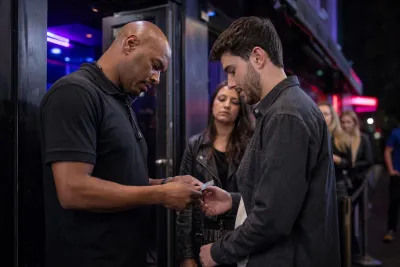
Professional door staff and security personnel rely on structured sensory inspection protocols to identify non-genuine credentials before electronic tools are applied. This workflow centers on tactile evaluation, optical characteristics, and micro-features:
- Card Rigidity and Substrate: Genuine state driver's licenses are constructed from specialized multi-layer polycarbonate or Teslin composite materials standard to CR80 specifications (30 mil thickness). Counterfeit credentials printed on lower-grade PVC or laminated synthetic paper often display uneven flex resistance or delaminating edges.
- Tactile Surface Features: Many state credentials incorporate laser-engraved tactile lettering for cardholder names, license numbers, and birthdates, creating distinct raised embossing.
- Ultraviolet (UV) Response: Under a 365nm long-wave ultraviolet light, authentic state credentials reveal sharp fluorescent images or state seals. Inauthentic cards frequently display washed-out fluorescent bleeding or lack reactive compounds altogether.
- Microprinting Clarity: Authentic credentials contain crisp, microscopic text along state borders or signature lines that remain legible under a 10x inspection loupe. Non-genuine documents produced on commercial desktop printers exhibit pixelation or broken lettering.
In high-volume environments, electronic ID scanners supplement manual checks by decoding the PDF417 two-dimensional barcode printed on the reverse side of state driver's licenses. The American Association of Motor Vehicle Administrators (AAMVA) standardizes data syntax, specifying field positions for name, address, birthdate, and license number. Electronic scanners perform mathematical checksum validation and flag internal syntax inconsistencies.
Comparison: Verification Methods and State Compliance Frameworks
Hospitality venues select verification methods based on patron throughput, regulatory environment, and security risk profiles.
| Verification Method | Primary Detection Mechanism | Verification Speed | Strengths & Compliance Defense | Operational Limitations |
|---|---|---|---|---|
| Manual Physical Inspection | Tactile check, 10x loupe, UV light, visual photo match, patron questioning | 15–30 seconds per patron | Evaluates cardholder behavior; detects physical substrate defects and raised tactile engraving | Subject to human fatigue and lighting conditions; produces no auditable digital compliance log |
| Mobile 2D Barcode Scanner | PDF417 barcode decoding, AAMVA syntax check, age math calculation | 1–3 seconds per patron | High throughput; eliminates staff calculation errors; generates timestamped entrance records | Reads barcode data only; cannot detect a genuine ID presented by an underage lookalike |
| Multi-Spectrum Desktop Authenticator | Full optical OCR, UV/IR light analysis, front-to-back cross-match, hologram inspection | 4–8 seconds per patron | Highest detection depth; validates physical card security features and data syntax simultaneously | Higher hardware cost; stationary desktop footprint; slower throughput than handheld scanners |
State regulatory bodies establish specific standards regarding electronic age verification. In California, the Department of Alcoholic Beverage Control (ABC) mandates Responsible Beverage Service (RBS) training under AB 1221. In New York, the State Liquor Authority (SLA) recognizes electronic scanners as an affirmative defense in administrative proceedings. Texas Alcoholic Beverage Commission (TABC) rules provide safe harbor protections for certified venues using scanners, while the Florida Division of Alcoholic Beverages and Tobacco (ABT) enforces strict minor decoy operations.
Frequently Asked Questions
Do ID scanners actually work at detecting fake IDs?
Yes. ID scanners effectively detect counterfeit credentials that contain corrupted barcode syntax, invalid mathematical checksums, expired dates, or data payloads that fail to conform to AAMVA standards. Advanced multi-spectrum scanners also detect physical and optical discrepancies between the printed surface and the encoded barcode data.
What does an ID scanner check when it scans a license?
An ID scanner reads the PDF417 2D barcode on the back of the card, extracting the cardholder's legal name, date of birth, document expiration date, and issuing jurisdiction. The software performs immediate age calculations to verify the patron is at least 21 years old and checks the data structure against official state formatting standards.
Are venues legally required to use ID scanners?
Requirements vary by municipality and state jurisdiction. While most states do not impose a universal mandate requiring electronic scanners for all liquor license holders, many cities require scanners for high-capacity nightclubs, late-night venues, or establishments with prior ABC violations. In several states, using an electronic scanner provides a statutory affirmative defense if an inauthentic credential is encountered.
What happens if a venue serves a minor who used a fake ID?
The venue faces administrative penalties from state liquor authorities, including substantial fines and potential liquor license suspension or revocation. The server or bartender may receive a criminal misdemeanor citation. If the minor is subsequently involved in an accident causing injury or property damage, the venue faces civil liability under state Dram Shop laws.
What is the best ID verification method for a small bar or restaurant?
The most effective approach combines certified staff training (such as ServSafe Alcohol or state-mandated RBS programs) with a reliable handheld 2D barcode scanner and a handheld 365nm UV inspection light. This multi-layered approach ensures staff verify physical security features while confirming data validity through automated scanning.
Implementing rigorous age verification protocols is an essential operational standard for hospitality businesses across the United States. By integrating manual inspection standards, electronic scanning hardware, and regular staff compliance education, venue operators protect public safety, maintain regulatory standing, and preserve their commercial operating licenses.