Mobile Driver's Licenses (mDL) vs. Physical Cards: The Current State of ISO 18013-5 in the US
Mobile driver's licenses (mDLs) represent a significant technological evolution in how state motor vehicle agencies issue and authenticate identity credentials. Built upon cryptographic protocols rather than visual inspection of plastic laminates, digital credentials allow motorists to store government-issued identification directly on smartphones. As state departments of motor vehicles (DMVs) deploy mobile identity platforms, understanding technical standards, privacy controls, and operational limits of mDLs is essential for drivers, businesses, and compliance officers navigating identity verification across the United States.
The ISO/IEC 18013-5 Standard, Cryptography, and State Adoption
The technical foundation of mobile driver's licenses rests on ISO/IEC 18013-5, an international standard established by the International Organization for Standardization (ISO) and the International Electrotechnical Commission (IEC). This standard defines data structures, communication protocols, and cryptographic verification mechanisms necessary to convey driving credentials securely between a holder's smartphone and an inspecting device.
Unlike a digital photograph or static screenshot of a card, an ISO 18013-5 compliant mDL utilizes asymmetric public key cryptography. When a state DMV issues an mDL, it generates a Mobile Security Object (MSO) signed with the issuing authority's private cryptographic key. When a verifier inspects the credential, their reader verifies the digital signature against the state's public certificate, registered via trust frameworks such as the American Association of Motor Vehicle Administrators (AAMVA) Digital Trust Federation.
A core functional capability of ISO 18013-5 is selective disclosure. When presenting a physical card, the holder exposes their legal name, residential address, exact date of birth, and license number. Under ISO 18013-5, the user can authenticate specific attributes—such as confirming they are at least 21 years old—without releasing their home address or full name. Communication occurs via Near Field Communication (NFC) or Bluetooth Low Energy (BLE), ensuring the cardholder never relinquishes physical control of their device.
State adoption operates on a state-by-state basis. Several states, including Arizona, California, Colorado, Georgia, Maryland, and Iowa, permit residents to add digital credentials directly to Apple Wallet or Google Wallet, protected by hardware Secure Elements and biometric authorization. Other states, such as Louisiana (LA Wallet) and Utah (GET Mobile ID), maintain dedicated state applications providing integrated services alongside driving credentials.
Comparison: Mobile Driver's License vs. Physical Card
The structural characteristics of digital credentials and physical plastic cards differ significantly across verification workflows, privacy protections, and infrastructure dependencies.
| Evaluation Dimension | Mobile Driver's License (ISO 18013-5) | Physical Driver's License (REAL ID Card) |
|---|---|---|
| Issuing Authority | State DMV / Department of Public Safety via cryptographic certificate | State DMV / Department of Public Safety via physical card production |
| Verification Mechanism | Asymmetric public key cryptography via NFC or BLE data transfer | Visual inspection, tactile surface check, 2D PDF417 optical barcode scan |
| Privacy Control | Selective disclosure (transmits only required data fields, e.g., age > 21) | Full disclosure (all printed fields visible to inspector) |
| Federal Airport Acceptance | Accepted at designated TSA CAT-2 security checkpoints nationwide | Universally accepted at all TSA airport checkpoints and federal facilities |
| Law Enforcement Acceptance | Limited; dependent on local police department reader deployment | Standard required credential for roadside traffic stops across all 50 states |
| Hardware Dependency | Requires functional smartphone battery, operating system, and hardware reader | Zero battery or reader requirement; independent physical medium |
Current Acceptance Venues, TSA Checkpoints, and Practical Limitations
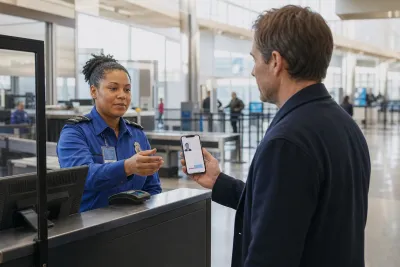
The primary federal agency accepting mobile driver's licenses is the Transportation Security Administration (TSA). The TSA has deployed Credential Authentication Technology 2 (CAT-2) units at security checkpoints in major commercial airports, including Phoenix Sky Harbor (PHX), Ronald Reagan Washington National (DCA), Denver International (DEN), and Baltimore/Washington International (BWI). At CAT-2 lanes, travelers tap their smartphone against an NFC terminal, authenticating identity without handing a physical card to security personnel.
Despite federal airport adoption, significant practical limitations require motorists to carry physical cards:
- Roadside Law Enforcement Stops: Most state highway patrols and municipal police departments are not yet outfitted with digital mDL readers. Officers cannot legally require drivers to hand over unlocked smartphones, nor do patrol cruisers uniformly support Bluetooth verification.
- Hospitality and Retail Acceptance: While select supermarket chains and pharmacies pilot digital age verification, the majority of hospitality establishments rely on optical barcode scanners or manual visual checks built for physical cards.
- Device Power and Hardware Failure: If a smartphone battery depletes or experiences hardware malfunction, the digital credential cannot be displayed, resulting in compliance failure during law enforcement stops.
State motor vehicle departments explicitly advise all drivers that an mDL functions as a companion credential rather than a complete legal substitute for the physical plastic card.
Frequently Asked Questions
Is a mobile driver's license accepted at TSA checkpoints?
Yes, but only at participating airport security checkpoints equipped with Credential Authentication Technology 2 (CAT-2) scanners. While TSA continues expanding CAT-2 deployment across domestic airports, travelers must carry their physical REAL ID-compliant card or U.S. passport, as non-participating checkpoints and international travel require physical documents.
Which states currently offer an mDL?
More than a dozen states have launched operational or pilot mDL programs, including Arizona, California, Colorado, Georgia, Maryland, Iowa, Utah, Louisiana, Mississippi, and Hawaii. Availability varies between direct integration with Apple Wallet and Google Wallet or proprietary state-issued mobile applications.
What happens if my phone dies — can I still use my mDL?
No. If your smartphone battery is depleted, powered off, or experiencing a hardware malfunction, the mDL cannot complete the cryptographic handshake with a verification reader. Because state motor vehicle codes mandate that drivers present valid proof of licensure upon lawful request, you must carry your physical card while driving.
Is mDL more secure than a physical card?
From a data verification and privacy standpoint, yes. ISO 18013-5 mDLs rely on asymmetric cryptography signed by the state issuing authority, making digital forgery mathematically infeasible. Furthermore, selective disclosure ensures that third-party verifiers receive only the specific data field requested, eliminating unnecessary exposure of home addresses and driver license numbers.
Can I use mDL to buy alcohol at a bar?
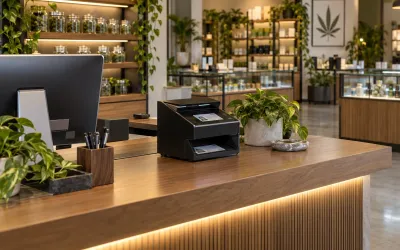
Acceptance at commercial venues depends entirely on local state liquor authority regulations and whether the establishment possesses an ISO 18013-5 compliant digital verifier. Because most hospitality venues still utilize optical barcode scanners or visual inspection, most bars and nightclubs cannot currently accept smartphone credentials.
The expansion of ISO 18013-5 compliant mobile driver's licenses establishes a robust, privacy-preserving standard for digital identity verification across the United States. As federal agencies, state motor vehicle administrations, and private software vendors continue expanding reader infrastructure, digital credentials will streamline verification workflows while existing alongside physical REAL ID cards as essential legal documents.