Polycarbonate vs. PVC Driver's Licenses: What Card Materials Tell You About Security and Durability
The physical composition of government-issued credentials plays a foundational role in identity document security, fraud prevention, and operational longevity. Across the United States, state departments of motor vehicles (DMVs) are steadily modernizing card manufacturing technologies, shifting from traditional polyvinyl chloride (PVC) and composite laminate cards to multi-layer polycarbonate (PC) substrates. Understanding the structural properties, manufacturing mechanisms, and tactile differences between polycarbonate and PVC is essential for identity verification professionals, forensic document examiners, and commercial compliance officers.
Material Science: Polycarbonate Fusion vs. Adhesive PVC Composites
The structural integrity of an identification card depends on how its constituent material layers are bonded during manufacturing:
- Polycarbonate (PC) Substrates: Polycarbonate is a high-grade thermoplastic polymer known for exceptional thermal resistance, optical clarity, and mechanical durability. In secure document production, multiple individual layers of polycarbonate film are fused together using high pressure and temperature in a specialized lamination press. The polymer chains cross-link, fusing the individual films into a single, monolithic solid plastic core without chemical adhesives or glues.
- PVC and Composite Laminates: Polyvinyl chloride (PVC) cards—often constructed with a Teslin or synthetic core—rely on pressure-sensitive or heat-activated adhesive glues to sandwich printed core sheets between clear protective plastic overlaminates.
Because PVC composite cards rely on adhesive bonding, they remain susceptible to physical separation, corner fraying, and environmental degradation over time. In contrast, solid polycarbonate cards cannot be mechanically delaminated without destroying the entire physical card body, making physical alteration impossible.
Laser Engraving Technology vs. Surface Printing Mechanisms
The transition to polycarbonate fundamentally transforms how personal biographical data and portraits are applied to the card body:
- Surface Printing on PVC: Traditional PVC credentials utilize direct-to-card dye-sublimation or thermal transfer printing. In these systems, inks and color ribbons are deposited on top of the synthetic core sheet before an outer laminate layer is applied. Because the imagery sits on the surface, alteration attempts historically targeted lifting the protective laminate to scrape, bleach, or replace surface printed text.
- Sub-Surface Laser Engraving in Polycarbonate: Polycarbonate credentials eliminate surface printing inks for core biographical fields. Instead, state manufacturing facilities utilize focused industrial laser engraving systems. The carbon-doped inner layers of the polycarbonate react chemically to the infrared laser beam, turning carbon particles black beneath the card surface. The cardholder's legal name, birthdate, license number, and high-resolution grayscale portraits become permanently embedded inside the solid plastic body.
- Tactile Surface Engraving: Laser engraving allows for distinct tactile relief—raised lettering on critical text fields that can be immediately felt by human touch and inspected under oblique light.
Comparison: Polycarbonate vs. PVC/Composite Credentials
The table below summarizes the material, security, tactile, and longevity differences between polycarbonate and PVC composite driver's licenses.
| Evaluation Dimension | Polycarbonate (PC) Driver's License | PVC / Teslin Composite Driver's License |
|---|---|---|
| Structural Construction | Monolithic fused thermoplastic core (heat and pressure fusion) | Adhesive-bonded multi-layer sandwich with protective plastic overlaminate |
| Delamination Resistance | 100% delamination-proof; layers cannot be separated mechanically | Vulnerable to edge peeling, corner fraying, and mechanical delamination |
| Data Application Method | Sub-surface industrial laser engraving (carbonized black data) | Surface thermal transfer, dye-sublimation, or pigment inkjet printing |
| Tactile Surface Features | Distinct raised tactile lettering on name, DOB, and license number | Generally smooth, flat surface with printed top overlaminate |
| Acoustic / Drop Test | Produces a sharp, high-pitched metallic chime when dropped on a hard surface | Produces a dull, muted plastic thud when dropped on a hard counter |
| Flexibility & Rigidity | High rigidity; snaps back instantly with high resistance to creasing | Flexible; prone to permanent bending, warping, or white stress lines |
| Expected Lifespan | 10+ years without structural degradation or layer separation | 3 to 5 years before edge wear, peeling, or fading occurs |
| Adopting US States (Examples) | New York, Texas, California, Colorado, Maryland, Washington | States maintaining older card generation contracts |
Frontline Verification Checks and Advanced Security Integration
Frontline document verifiers, bouncers, bank tellers, and law enforcement officers utilize quick sensory checks to evaluate card material:
- The Drop / Tap Acoustic Check: Dropping a genuine polycarbonate card onto a solid surface produces a distinctive metallic ringing sound resembling a metallic coin or compact disc, caused by the density and polymer resonance of fused polycarbonate.
- The Tactile Friction Test: Running a thumb or fingernail across the cardholder's birthdate or name reveals sharp raised ridges formed by laser engraving. A flat, smooth surface across all text fields indicates surface printing rather than true laser engraving.
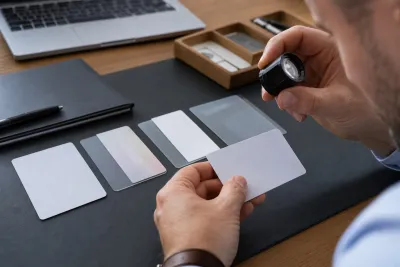
- Perimeter Edge Inspection: Under a 10x inspection loupe, a polycarbonate card exhibits a continuous, monolithic edge profile with zero adhesive lines. A PVC composite card displays visible layer stratification or adhesive seams along its borders.
In addition to material strength, polycarbonate enables state motor vehicle agencies to integrate advanced Level 1 and Level 2 security features. These include transparent optical windows housing secondary laser-engraved portraits, Multiple Laser Images (MLI) that change viewing angles from birth year to expiry date, and laser-perforated micro-holes that reproduce the cardholder portrait against backlighting.
Frequently Asked Questions
What material is a modern US driver's license made of?
Most recently redesigned state driver's licenses are constructed from solid multi-layer polycarbonate. Some states still utilize composite PVC/Teslin materials, though motor vehicle agencies are rapidly transitioning to polycarbonate during contract renewal cycles.
Can you delaminate a polycarbonate driver's license?
No. Fused polycarbonate cards form a single, solid piece of plastic during manufacturing. Because no adhesive glues are used to bind the layers, mechanical delamination is physically impossible without tearing or melting the plastic itself.
How can I tell if a driver's license is polycarbonate or PVC?
Perform three physical checks: feel for raised tactile laser engraving on personal data fields, drop the card on a table to hear if it produces a metallic chime, and check the edges under magnification for the absence of laminate seams.
Why do some driver's licenses feel thicker or stiffer than others?
While all state driver's licenses conform to the standard CR80 thickness specification (30 mil or 0.76 mm), polycarbonate possesses a significantly higher flexural modulus than PVC, making it feel noticeably stiffer and more rigid.
Does card material affect REAL ID compliance?
The federal REAL ID Act sets functional security and data verification standards rather than mandating a specific polymer. However, most state DMVs adopt polycarbonate when upgrading their credentials to satisfy federal anti-counterfeiting requirements efficiently.
The adoption of multi-layer polycarbonate represents a defining milestone in identity credential security across the United States. By combining laser-engraved data, indestructible monolithic construction, and raised tactile surfaces, polycarbonate credentials provide verifiers with immediate, reliable verification tools while safeguarding personal identity against document tampering.