Driver's License Renewal: State-by-State Requirements, Online Options, Grace Periods, and Fees
Maintaining an active, unexpired driver's license is a fundamental legal obligation for motorists operating vehicles across the United States. State departments of motor vehicles (DMVs) establish distinct statutory renewal intervals, application procedures, fee schedules, and grace periods under state vehicle codes. Navigating the license renewal process efficiently—whether renewing online, visiting a local field office, or upgrading to a REAL ID-compliant credential—requires understanding state-specific renewal criteria and documentation rules.
Renewal Intervals and Statutory Expiration Timelines
The validity period of a standard driver's license varies by state jurisdiction. While most states issue licenses valid for four to eight years, renewal cycles often correlate with the driver's age:
- Standard Adult Validity Cycles: Adult drivers between ages 21 and 65 typically receive credentials valid for 4 years (e.g., New Jersey, Pennsylvania), 5 years (e.g., California, Texas), 6 years (e.g., Georgia), or 8 years (e.g., New York, Florida, Washington).
- Senior Citizen Renewal Schedules: Many states adjust renewal cycles for drivers aged 65, 70, or 75 and older. Senior drivers may be required to renew more frequently (e.g., every 2 to 4 years) and complete in-person vision evaluations or road knowledge screenings to ensure driving safety.
- Under-21 Milestone Renewals: Licenses issued to drivers under age 21 often expire exactly on the cardholder's 21st birthday, requiring prompt renewal to transition to standard adult horizontal credentials.
State-by-State Renewal Comparison: 12 Major States
The table below summarizes standard renewal intervals, online portal availability, grace periods, estimated fee ranges, and vision testing requirements across 12 representative states.
| State Licensing Agency | Standard Renewal Interval | Online Renewal Available | Grace Period After Expiration | Estimated Renewal Fee | Vision Test at In-Person Renewal |
|---|---|---|---|---|---|
| California (DMV) | 5 years (expires on birthday) | Yes (eligible every other cycle) | Zero days (expired immediately) | $41.00 – $45.00 | Mandatory for in-person renewals |
| Texas (DPS) | 8 years (ages 18–84) | Yes (alternate cycles online) | Up to 2 years to renew without re-test | $33.00 | Mandatory at in-person appointments |
| New York (DMV) | 8 years | Yes (with online vision registry test) | Up to 2 years without road test | $64.50 – $80.50 (county dependent) | Mandatory vision test required |
| Florida (FLHSMV) | 8 years (under 80) / 6 years (80+) | Yes (one online renewal allowed) | 30 days (delinquent fee applies) | $48.00 | Mandatory for drivers 80 and older |
| Illinois (SOS) | 4 years (under 81) | Yes (Safe Driver Renewal program) | Zero days (expired immediately) | $30.00 | Mandatory for in-person visits |
| Pennsylvania (PennDOT) | 4 years (expires day after birthday) | Yes (with photo on file) | Zero days (expired immediately) | $35.50 – $40.50 | Selective screening on referral |
| Ohio (BMV) | 4 years / 8-year option (ages 21–65) | Yes (via BMV Online Services) | 6 months before re-testing required | $27.75 (4-yr) / $55.50 (8-yr) | Mandatory for in-person renewals |
| Georgia (DDS) | 8 years | Yes (every other renewal cycle) | Up to 2 years without re-test | $32.00 ($27.00 online discount) | Mandatory for drivers 64 and older |
| North Carolina (NCDMV) | 8 years (ages 18–65) / 5 years (66+) | Yes (alternate cycles online) | Up to 2 years before full re-test | $5.50 per year ($44.00 for 8-yr) | Mandatory sign & vision check |
| Michigan (SOS) | 4 years (expires on birthday) | Yes (every other cycle online) | Zero days (late fee applies) | $18.00 | Mandatory for in-person appointments |
| Virginia (DMV) | 8 years | Yes (eligible alternate cycles) | Zero days (late renewal permitted) | $32.00 | Mandatory for in-person renewals |
| Washington (DOL) | 6 years / 8-year option | Yes (online via License eXpress) | Up to 60 days before late fee | $54.00 (6-yr) / $72.00 (8-yr) | Screening at in-person offices |
Online Renewal Eligibility and Required Documentation
Most state motor vehicle departments permit drivers to renew credentials online, saving significant time. However, online renewal eligibility is governed by statutory parameters:
- Alternate In-Person Requirements: Most states operate on an alternating cycle rule. If you renewed online during your last cycle, you must visit a field office in person for your next renewal to update your photo, biometric signature, and vision screening.
- Unchanged Residential Address: Online renewal requires that your address on record remains accurate. If you have moved, you must update your address before or during the renewal process.
- Commercial Drivers and Suspensions: Commercial Driver License (CDL) holders requiring medical card updates and drivers with active license suspensions or outstanding traffic citations cannot renew online.
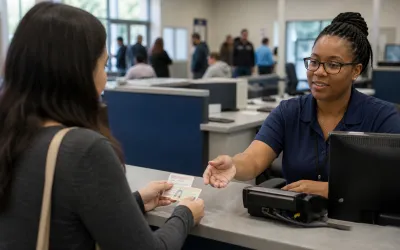
When renewing in person, drivers must present their current license, proof of Social Security number, and payment for state fees. If upgrading to a REAL ID for the first time during renewal, applicants must provide full original source documentation: proof of identity and lawful status (e.g., birth certificate or passport), proof of Social Security number (e.g., Social Security card or W-2), and two proofs of physical state residency (e.g., utility bills or bank statements).
Legal Consequences of Driving on an Expired License
Allowing a driver's license to expire creates immediate legal liabilities. In all 50 states, operating a motor vehicle on an expired credential is a violation of state traffic codes, typically charged as an infraction or misdemeanor citation carrying fines ranging from $50 to over $500.
Furthermore, an expired license cannot be used as a valid photo ID for commercial air travel at TSA checkpoints after standard expiration buffers or for completing Form I-9 employment verifications. Motorists deployed on active military duty overseas receive statutory extensions under the Servicemembers Civil Relief Act (SCRA) and state military extension provisions, granting extended validity until returning from deployment.
Frequently Asked Questions
How early can I renew my driver's license before it expires?
Most states permit drivers to initiate renewal between 6 months and 1 year prior to the expiration date. In states like California and Texas, renewal notices are typically mailed 60 to 90 days before expiration.
Can I renew my driver's license online?
Yes, provided you satisfy your state's online eligibility criteria: your driving record is clean, your current photo is within the state's validity window, your address has not changed, and you did not renew online during the immediate preceding cycle.
What happens if I drive with an expired license?
Driving on an expired license is a statutory traffic offense in all states. You may receive a traffic citation, incur fines, have points assessed against your record, or have your vehicle impounded if stopped by law enforcement.
Do I need to take a driving test to renew my license?
Under normal circumstances, no. Routine renewals do not require a behind-the-wheel road test. However, if your license has been expired for an extended period (typically more than 1 to 2 years) or if a medical review is requested, the DMV may require re-taking the road exam.
Can I renew my license if I moved to a new state?
No. Driver's licenses cannot be renewed across state lines. If you establish permanent residency in a new state, state laws require you to surrender your out-of-state license and apply for a new resident driver's license within 30 to 90 days of moving.
Managing driver's license renewal in a timely manner prevents legal disruptions, traffic citations, and administrative penalties. By taking advantage of online renewal portals, monitoring expiration cycles, and preparing necessary documentation for in-person appointments, drivers ensure uninterrupted driving privileges and compliant identification credentials.