Digital Mobile Driver's License Verification Guide
The transition from physical documentation to digital identity verification represents a significant evolution in regulatory compliance and commercial security. The emergence of the mobile driver's license (mDL) introduces new protocols that businesses and security personnel must understand to properly authenticate individuals. Unlike traditional physical cards, digital identification relies on complex cryptographic standards, fundamentally altering how identity is presented and verified. For commercial entities, adapting to this technology is not merely a matter of convenience; it is an essential requirement for maintaining robust compliance in an increasingly digital landscape. This guide explores the technical foundations of the mDL standard, the landscape of state adoption, and the necessary procedures for secure electronic verification.
As state agencies roll out digital identity programs, frontline staff must be educated on the distinction between an official mDL and an unverified digital image. A mere photograph of a license stored on a smartphone is categorically invalid for any legal or commercial verification purpose. Official digital IDs operate under strict international standards, ensuring that data is securely transmitted and cryptographically authenticated. Understanding this framework is crucial for preventing the acceptance of a fake ID that relies on deceptive visual manipulation on a mobile screen. By implementing appropriate verification technologies, businesses can protect themselves against identity document fraud and navigate the complexities of this digital transition.
Understanding the mDL ISO 18013-5 Standard
The foundation of secure digital identity lies in the ISO 18013-5 standard, an internationally recognized framework governing the implementation and verification of mobile driving licenses. This standard ensures interoperability, allowing a digital ID issued in one jurisdiction to be securely verified by a relying party in another. The protocol dictates that the identity data is securely provisioned by the issuing authority directly to the user's mobile device, utilizing advanced cryptographic signing to guarantee the integrity and authenticity of the information.
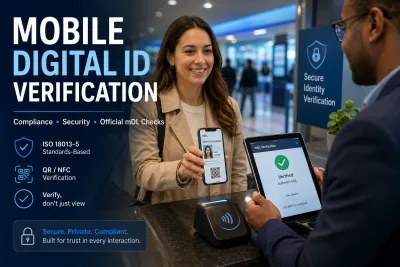
When a transaction occurs, the ISO 18013-5 standard facilitates the secure exchange of data between the mobile device and the verifier's system. This process occurs via near-field communication (NFC), QR codes, or Bluetooth, rather than relying on a visual inspection of the screen. The verifier's system receives the cryptographically signed data package and confirms the signature against the issuing authority's public key. This electronic handshake ensures that the data has not been altered in transit and originates from a legitimate government source, significantly reducing the viability of a scannable fake ID application attempting to spoof the verification process.
Furthermore, the standard emphasizes data minimization and privacy. It allows the user to present only the specific information required for the transaction, such as proof of age, without revealing unnecessary personal details like their full address or exact date of birth. This cryptographic approach provides a level of security and privacy that physical documents cannot match, but it absolutely requires businesses to utilize compatible verification hardware and software to interface with the standard properly.
State Adoption and Acceptance Status
The implementation of mobile driver's licenses is a phased process, with various states operating at different stages of development, pilot testing, and full public deployment. This fragmented landscape creates challenges for businesses, particularly those operating across multiple jurisdictions or in regions with high tourist traffic. Verifying personnel must remain informed about which states currently issue compliant digital IDs and the specific legal acceptance criteria within their operational area. Failing to understand these nuances can lead to compliance violations or unnecessary customer friction.
Currently, several states have launched official digital identity applications or integrated their credentials into major mobile wallet platforms. However, legislative acceptance of these digital formats for specific use cases, such as age-restricted purchases or law enforcement interactions, varies significantly. In some jurisdictions, an mDL is fully recognized for purchasing alcohol, while in others, it remains legally insufficient, necessitating the presentation of a physical card. Businesses must closely monitor state-specific regulations to ensure their verification policies align with current legal mandates.
| State Status | Age Verification (Alcohol/Tobacco) | TSA / Law Enforcement Acceptance |
|---|---|---|
| Active Official Program (e.g., Arizona, Maryland) | Legally accepted in specific participating establishments. | Accepted at select TSA checkpoints; limited law enforcement use. |
| Integration with Major Wallets (e.g., Apple Wallet) | Acceptance depends heavily on local jurisdiction laws. | Accepted at designated airport security lines equipped with proper scanners. |
| Pilot Testing Phase | Generally not accepted for regulated commercial transactions. | Restricted to controlled testing environments. |
| No Current Program | Digital formats entirely invalid; physical ID required. | Physical identification strictly enforced. |
Cryptographic Security vs Physical Alterations
The security paradigm of digital identification relies entirely on cryptographic integrity, presenting a stark contrast to the physical security features of traditional cards. A physical document defends against forgery through complex manufacturing processes, utilizing holograms, specialized inks, and intricate lamination. Conversely, a digital ID's security is mathematically enforced. The data is encrypted and signed by the issuing state, making unauthorized alteration virtually impossible without compromising the state's private cryptographic keys.
This cryptographic reliance neutralizes traditional forgery techniques. A perpetrator cannot physically scrape, reprint, or manipulate the data on an official mDL app. However, this shift introduces new vectors for deception. The primary threat involves individuals presenting a fake ID California or a fake ID New York digital replica—a standalone application designed to visually mimic the interface of an official state app. These spoofing applications rely entirely on the verifier performing a visual inspection rather than conducting a proper cryptographic data exchange.
To combat these digital forgeries, businesses must implement electronic verification protocols. A digital ID must never be authenticated merely by looking at the screen or watching an animated graphic within the app. The verification must involve scanning the associated QR code or utilizing NFC to initiate the cryptographic handshake defined by the ISO standard. If the digital credential cannot pass this electronic cryptographic verification, it must be categorically rejected as fraudulent.
Practical Limitations of Digital IDs
Despite their advanced security capabilities, mobile driver's licenses present several practical limitations that necessitate the continued reliance on physical documentation. The most obvious constraint is the reliance on battery power and a functioning electronic device. If a user's phone is inactive, damaged, or unable to communicate via NFC or Bluetooth, the digital ID is entirely inaccessible. Consequently, most issuing authorities strongly advise users to carry their physical credentials as a reliable backup.
Furthermore, the current lack of universal verification infrastructure poses a significant hurdle. While larger commercial entities and federal agencies like the TSA are equipping themselves with ISO-compliant readers, many smaller businesses, bars, and local law enforcement agencies lack the necessary hardware to cryptographically verify an mDL. In these environments, presenting a digital ID often leads to confusion or outright rejection, as staff cannot properly authenticate the credential beyond an unreliable visual check, raising concerns about counterfeit ID presentation.
Finally, the variance in user interfaces across different state applications and mobile wallet integrations complicates the verification process for frontline staff. Without a uniform visual standard, employees may struggle to differentiate between a legitimate out-of-state mDL and a sophisticated spoofing application. Until verification hardware becomes ubiquitous and standardized, these practical limitations require businesses to maintain flexible yet rigorous policies that accommodate digital identification securely while falling back on physical verification when necessary.
Is a mobile driver's license legally accepted everywhere?
No. The legal acceptance of mobile driver's licenses varies significantly by jurisdiction and use case. While they are increasingly accepted at select TSA checkpoints, many states do not yet legally recognize them for age-restricted purchases or law enforcement traffic stops, requiring a physical card.
How does a business verify a digital ID?
A digital ID must be verified electronically using an ISO 18013-5 compliant reader via NFC, Bluetooth, or QR code scanning. This initiates a cryptographic handshake with the issuing authority to ensure the data is authentic. Visual inspection of the mobile screen is entirely insufficient for verification.
Can a digital ID be faked?
While the cryptographic data of an official digital ID cannot be easily forged, perpetrators often use spoofing applications designed to visually mimic the state's app interface. These deceptive applications can trick verifiers who rely solely on visual inspection rather than electronic cryptographic verification.
Which states currently have active mDL programs?
The landscape is constantly evolving, but several states, including Arizona, Maryland, Colorado, and Georgia, have launched active programs, often integrating with major mobile wallet platforms. Many other states are currently in the legislative or pilot testing phases of implementation.
What happens if someone presents an unofficial ID app?
If an individual presents an unverified digital image or a standalone spoofing application, it will fail to complete the required cryptographic handshake with an ISO-compliant reader. The establishment must reject the credential immediately and require a valid, verifiable physical form of identification to proceed.
The integration of mobile driver's licenses represents a fundamental shift in identity verification, demanding an upgrade in both technological infrastructure and staff training. By adhering to the cryptographic principles of the ISO 18013-5 standard and remaining vigilant against digital spoofing tactics, businesses can harness the enhanced security of digital IDs while maintaining strict compliance. As state adoption continues to expand, maintaining a rigorous, technology-driven verification protocol is essential for mitigating the risks of identity document fraud in a modernized commercial environment.