When is a Student ID Legally Valid
The reliance on various forms of identification presents a continuous challenge for compliance and security personnel. Understanding the precise legal validity of a student ID compared to primary government documentation is essential for organizations that require stringent identity verification. While institutional identification serves important functions within academic and specific local contexts, its applicability in broader legal, commercial, and federal scenarios is strictly limited. Recognizing the boundaries of secondary identification helps businesses and institutions prevent unauthorized access and maintain adherence to regulatory standards. This comprehensive guide clarifies the hierarchy of identity documents, detailing when and where a student ID is considered legally acceptable and when it falls short of required verification thresholds.
The fundamental distinction between state-issued driver's licenses and institutional cards lies in the rigor of the issuance process. Primary identification requires extensive background checks and cryptographic verification, establishing a high degree of confidence in the document's authenticity. Conversely, secondary documents often rely on less secure issuance protocols, making them more susceptible to forgery. Businesses evaluating these documents must be acutely aware of the associated risks, particularly the prevalence of a fake ID designed to mimic university credentials. By establishing clear policies regarding acceptable documentation, organizations can effectively mitigate the liabilities associated with ID fraud and ensure compliance with state and federal regulations.
Hierarchy of Identity Documents
In the realm of legal identity verification, documents are categorized within a strict hierarchy based on their security features and issuance criteria. At the apex of this hierarchy are primary government IDs, such as passports, state-issued driver's licenses, and national identity cards. These documents are universally recognized due to the exhaustive vetting processes required prior to issuance. They incorporate advanced anti-counterfeiting technologies, including microprinting, laser engraving, and biometric data integration, establishing an authoritative proof of identity and age.
Secondary identification documents, which include student IDs, employee badges, and certain local utility records, occupy a lower tier within this framework. These documents are typically issued for specific organizational purposes and lack the robust security infrastructure of primary IDs. While they may confirm affiliation with a particular institution, they are rarely sufficient on their own to satisfy legal requirements for age verification, employment eligibility, or high-security access. The legal limitations of secondary identification are a critical concept for compliance officers, as accepting these documents in inappropriate contexts can lead to severe regulatory penalties.
Understanding this hierarchy allows businesses to implement tiered verification systems. For low-risk transactions, such as accessing a student discount, a secondary ID may be acceptable. However, for highly regulated activities, such as the purchase of alcohol or the completion of federal employment forms, only documents from the primary tier are legally valid. Maintaining this distinction is essential for protecting the establishment against the risks of counterfeit ID presentation and ensuring overall operational compliance.
Comparing Primary Government IDs and Institutional IDs
The structural and procedural differences between government and institutional identification are stark. State authorities possess access to extensive databases and utilize sophisticated cryptographic verification methods during the issuance process. This ensures that the biographical data linked to the document is accurate and secure. Institutional IDs, on the other hand, are often generated using commercial printing equipment with minimal integration into external verification databases. This disparity makes institutional cards significantly more vulnerable to duplication and alteration by individuals attempting to bypass security measures.
When comparing the physical attributes, primary IDs exhibit a complexity that is difficult to replicate without specialized industrial equipment. They feature integrated laminates, tactile elements, and complex holographic designs. Institutional documents frequently rely on standard PVC card printing with basic barcode or magnetic stripe technology. Because these secondary features are easily reproducible, a scannable fake ID mimicking a university credential is a common tool for individuals attempting to misrepresent their identity or age in less stringent environments.
| Verification Context | Acceptable Document Types | Does Student ID Qualify? |
|---|---|---|
| Age-Restricted Purchases (Alcohol/Tobacco) | State Driver's License, Passport, Military ID | No; legally insufficient for age verification. |
| Federal Form I-9 (Employment Eligibility) | Passport (List A), State ID (List B) + SSN (List C) | Yes, under specific List B conditions, but only establishes identity, not employment authorization. |
| Domestic Air Travel (TSA Checkpoint) | REAL ID Compliant State ID, Passport | No; not recognized as primary federal identification. |
| Retail Student Discounts | University Issued ID Card, .edu Email | Yes; primary intended use case for institutional documents. |
Risks and Alteration Tactics
The lower security standards associated with institutional identification make them frequent targets for forgery and alteration. Unlike a state-issued document, which requires overcoming significant cryptographic and physical barriers, a student credential can often be manufactured using commercially available card printers and graphic design software. This accessibility has led to a proliferation of fake ID Texas or fake ID Florida university variants, which are primarily utilized by underage individuals attempting to gain entry into restricted venues or bypass local regulations.
Common alteration tactics involve manipulating the date of birth, modifying the expiration date, or completely fabricating the document based on a genuine template. Because institutional cards frequently lack advanced features like optical variable ink or complex micro-text, visually identifying a forgery relies heavily on recognizing inconsistencies in typography, photo quality, and card material. Personnel responsible for checking identification must be trained to critically evaluate the physical properties of the card, feeling for improper lamination or examining the document under specialized lighting to detect anomalies.
The risk extends beyond simple age misrepresentation; fraudulent secondary IDs can be used in tandem with other compromised data to facilitate broader identity document fraud. When evaluating any identification that falls outside the primary government tier, businesses must exercise elevated scrutiny. Implementing policies that require secondary verification, such as cross-referencing the ID with an institutional database when possible, is a vital step in mitigating these vulnerabilities and maintaining a secure environment.
Acceptable Requirements for Secondary Identification
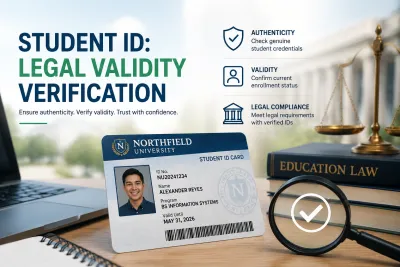
In contexts where secondary identification is permissible, establishing strict acceptable requirements is crucial for minimizing risk. When an organization decides to accept institutional cards for specific purposes, they must define clear parameters regarding the necessary features the document must possess. A valid secondary ID should always include a clear, recent photograph of the bearer, the full legal name, the name of the issuing institution, and a defined expiration date. Documents lacking any of these fundamental elements should be categorically rejected.
Furthermore, businesses must remain vigilant regarding the physical condition of the card. Any signs of tampering, such as peeling laminate, inconsistent edge cutting, or blurred printing, are immediate red flags indicating a potential forgery or a fake ID laws violation. Institutions themselves are increasingly adopting enhanced security features for their campus cards, such as embedded smart chips or proximity technology. When verifying these newer generations of institutional identification, personnel should be trained to utilize the corresponding electronic validation methods rather than relying solely on visual inspection.
Implementing a comprehensive policy for secondary identification involves regular review and adaptation. As counterfeiting techniques evolve, the criteria for accepting institutional documents must also be updated. Providing ongoing training to frontline staff ensures that they are equipped to recognize the limitations of secondary IDs and apply the organization's verification standards consistently, thereby protecting the business from regulatory scrutiny and operational risk.
Can a student ID be used for alcohol purchase?
No. Under state regulations governing age-restricted sales, a student ID is not considered a legally valid document for verifying age. Establishments must require primary government-issued identification, such as a driver's license or passport, to ensure compliance with alcohol control laws.
Is a student ID enough for employment verification?
A student ID can sometimes be utilized as a List B document (establishing identity) for the federal Form I-9, provided it includes a photograph or specific identifying information. However, it must always be accompanied by a List C document (establishing employment authorization), such as a Social Security card.
What is the difference between primary and secondary ID?
Primary IDs are government-issued documents that undergo rigorous background verification and incorporate advanced, standardized security features. Secondary IDs, like institutional cards, are issued for specific organizational purposes with lower security standards and limited legal applicability.
Can a student ID be used for domestic air travel?
No. The Transportation Security Administration (TSA) requires travelers to present acceptable primary identification, such as a REAL ID-compliant state driver's license or a U.S. passport. Institutional identification does not meet the federal security requirements for air travel.
What makes student IDs less secure than state IDs?
Student IDs are generally produced with fewer anti-counterfeiting technologies, lacking features like complex holograms, microprinting, and integrated cryptographic data. The less rigorous issuance process and reliance on standard card printing materials make them significantly easier to forge or alter.
Navigating the legal validity of various identification documents requires a clear understanding of the established hierarchy and the specific requirements of different regulatory environments. While secondary institutional identification has legitimate organizational uses, its limitations in legal and commercial contexts must be strictly observed. By implementing robust verification protocols and prioritizing primary government documentation, businesses and institutions can effectively safeguard their operations against the persistent threats of document alteration and identity misrepresentation.