Cannabis Dispensary ID Scanners vs. Bar Scanners Explained
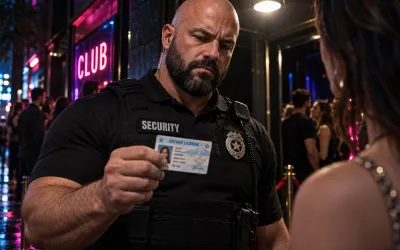
Consumers visiting licensed adult-use cannabis retailers frequently encounter an unexpected hurdle: identification credentials that easily gain entry at local bars and nightclubs are abruptly rejected at the dispensary reception desk. This stark operational divide leads many patrons to wonder what makes a cannabis dispensary ID scanner so fundamentally different from the handheld tools deployed across nightlife hospitality. While both environments legally restrict access to adults aged twenty-one and older, the technological infrastructure, operational scrutiny, and regulatory liability governing cannabis retail exist on an entirely different scale. Understanding why this verification gap exists requires examining the technical mechanics of identity inspection hardware alongside the unforgiving state oversight applied to legal cannabis.
Regulatory Asymmetry: Cannabis Compliance vs. Traditional Liquor Control
The primary driver behind the sophistication of dispensary identity verification is legal liability asymmetry. In the traditional hospitality sector, state Alcohol Beverage Control (ABC) agencies enforce compliance through progressive penalty structures. If a tavern or sports bar serves an underage patron, a first-time violation typically results in a civil fine ranging from $500 to $2,500, or a temporary license suspension spanning several days. While damaging, these infractions rarely destroy the enterprise immediately.
Legal cannabis dispensaries face existential regulatory consequences for the exact same infraction. State licensing authorities—such as California's Department of Cannabis Control or Massachusetts' Cannabis Control Commission—operate under intense federal scrutiny. To maintain state legal status, commercial cannabis relies on state-mandated seed-to-sale tracking systems, such as METRC. Every single gram of product must be linked to a verified commercial transaction. Selling cannabis to a minor is categorized as a catastrophic compliance failure, resulting in immediate administrative license revocations, civil penalties exceeding $50,000, and the mandatory forfeiture of millions of dollars in retail inventory. Because dispensaries cannot afford a single error, operators invest heavily in commercial verification hardware.
Technical Limits: How Hospitality Bar Scanners Function
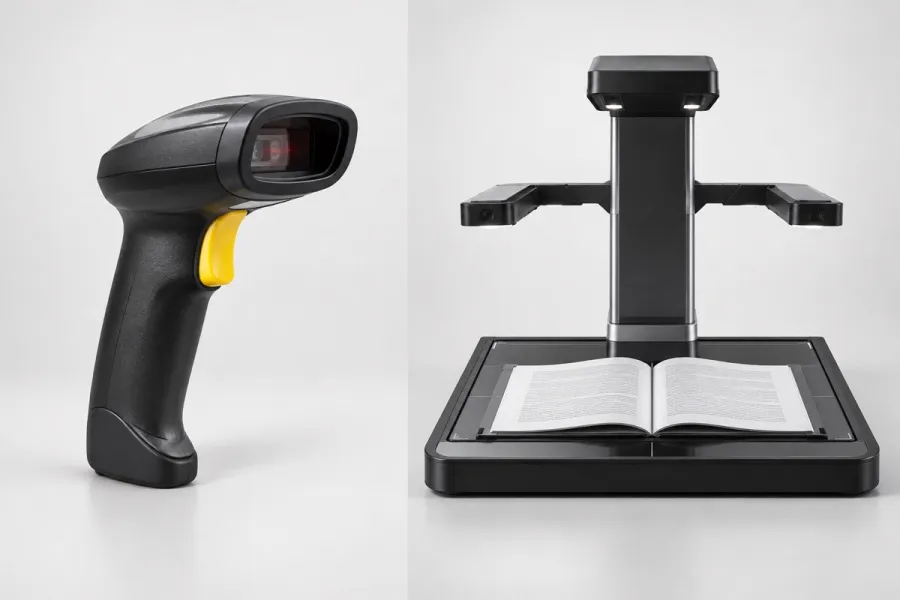
Most bars and entertainment venues rely on entry-level handheld scanners or mobile device applications designed for speed rather than forensic validation. These devices focus exclusively on reading the two-dimensional PDF417 barcode printed on the reverse side of North American driver's licenses, standardized by the American Association of Motor Vehicle Administrators (AAMVA).
Crucially, hospitality barcode readers operate entirely in offline mode. The device does not communicate with state Department of Motor Vehicles (DMV) databases or external law enforcement registries. Instead, the scanner merely decodes the unencrypted text string stored within the barcode, checking whether the data fields match expected AAMVA syntax headers and calculating age from the encoded birthdate. If an unauthorized credential contains properly formatted text with valid mathematical checksums, a basic hospitality reader will flash a green approval light. As outlined in our age verification compliance guide for businesses, standard bar readers provide an initial operational filter, but they cannot verify whether the physical plastic card is authentic or legally issued.
Forensic Capabilities of Dispensary Compliance Scanners
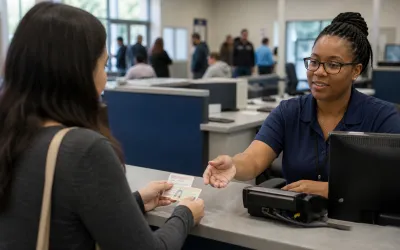
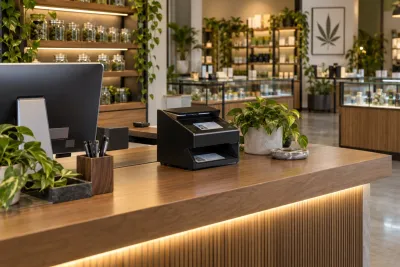
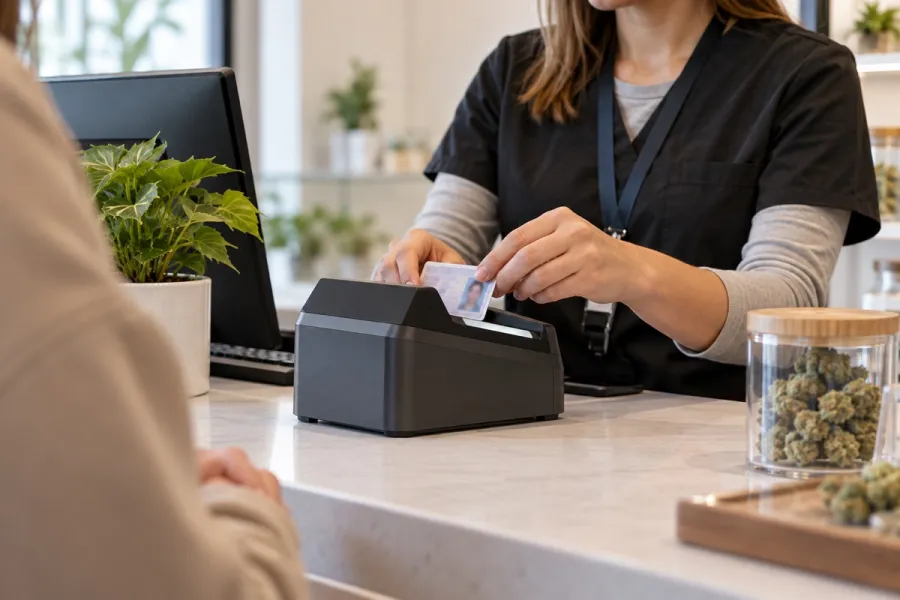
Unlike portable hospitality readers, licensed cannabis establishments deploy specialized dual-sided document readers. Commercial hardware from manufacturers such as E-Seek, Gemalto, and IDScan.net conducts multi-layered optical and physical analyses on every credential presented at the reception portal.
When a patron inserts a driver's license into a dispensary scanner, the unit executes multiple automated tests within three to five seconds:
- Multi-Spectral Optical Analysis: The scanner captures high-resolution digital images under visible, near-infrared (NIR), and ultraviolet (UV) light spectrums. It verifies whether state-specific fluorescent inks, ghost images, and microprinting appear in exact geometric coordinates.
- Substrate and Material Evaluation: The device inspects the physical composition of the card, distinguishing authentic multi-layer fused polycarbonate from counterfeit synthetic PVC laminates through optical transmission.
- Cross-Match Logic: The system automatically extracts data from the front face using optical character recognition (OCR) and compares every field—including name, license number, and birthdate—against the decrypted PDF417 barcode on the reverse side. Any typographic discrepancy triggers an immediate system alert.
These hardware defenses, detailed further in our overview of ID fraud detection technology for businesses, make it virtually impossible for documents that merely imitate barcode syntax to pass dispensary check-in desks.
System Comparison: Hospitality Bar Scanners vs. Dispensary Compliance Hardware
The operational gap between bar entry gates and cannabis dispensaries reflects distinct hardware architecture and regulatory stakes, as summarized below.
| Operational Dimension | Hospitality Bar Scanner | Cannabis Dispensary Compliance Scanner |
|---|---|---|
| Primary Inspection Mode | One-sided 2D PDF417 barcode decode | Dual-sided optical, infrared, and UV multi-spectral scan |
| Regulatory Mandate | State Alcohol Beverage Control (ABC) standards | State Cannabis Regulatory Commission and seed-to-sale tracking |
| Primary Risk for Business | Tiered administrative fine or short operational suspension | Immediate license revocation, criminal charges, and stock forfeiture |
| Substrate Verification | None; assumes physical authenticity if barcode parses | Measures infrared reflectivity, card thickness, and UV ink reactivity |
| Data Integration | Standalone offline device; rarely stores long-term logs | Directly integrated into retail Point-of-Sale (POS) and compliance logs |
Frequently Asked Questions
Why do dispensaries scan IDs differently than bars?
Dispensaries scan IDs differently because state cannabis regulations impose severe statutory penalties—including immediate license revocation and substantial fines—for underage sales. To protect their operating licenses, dispensaries utilize multi-spectral document readers that evaluate physical security features, whereas bars rely on basic barcode readers that only check text formatting.
Can a real, valid ID be rejected by a dispensary scanner?
Yes. A genuine state driver's license can be rejected if the card has physical damage, severe scratches across the 2D barcode, worn laminate, or faded ultraviolet security inks. In such cases, staff will typically request a secondary government credential, such as a valid passport.
What happens if a dispensary accepts a fake ID?
If a dispensary inadvertently admits an underage patron using a fraudulent credential, state regulators can suspend or revoke the retailer's operational license, levy substantial civil penalties, and seize inventory. Employees involved may also face misdemeanor criminal charges for furnishing cannabis to a minor.
Do medical cannabis dispensaries use the same scanners as recreational retailers?
Yes. Medical dispensaries utilize the same commercial document verification hardware to confirm legal age and identity, while adding a secondary verification step to check patient registry numbers against state Department of Health databases.
The technology gap between hospitality venues and licensed cannabis retail illustrates how commercial compliance adapts to regulatory pressure. While casual nightlife establishments continue to rely on rapid barcode readers, legal cannabis retail operates as one of the most strictly monitored consumer sectors in North America. Understanding the forensic capabilities of commercial dispensary scanning hardware clarifies why attempts to circumvent age verification protocols fail decisively at the dispensary door.