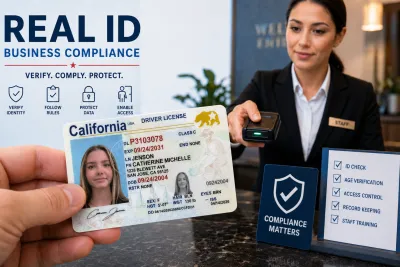
REAL ID Act Compliance for Businesses: A Comprehensive Educational Guide
Understanding the implications of federal identity standards is essential for commercial establishments operating in regulated sectors. The implementation of the REAL ID standard introduces significant changes to the way identity verification must be handled across the United States. Businesses, particularly those engaged in age-restricted sales, hospitality, and secure access, must adapt their internal procedures to remain compliant and mitigate the risks associated with accepting invalid documentation. When a customer presents identification, recognizing the nuances of federal markings can prevent substantial legal and financial repercussions. This guide provides a detailed overview of the federal standards, the characteristics of compliant documents, and the necessary adjustments commercial entities must make to their verification processes.
Historically, the reliance on disparate state-level identification formats created vulnerabilities within the system. The transition to a unified federal baseline aims to establish consistency and enhance the reliability of identity verification. For business owners and operators, this means moving beyond simple visual checks. A thorough understanding of the compliance timeline and the specific visual and physical security features of these updated documents is paramount. By educating staff on these standards, organizations can better protect themselves against the presentation of a fake driver's license or other forms of identity document fraud, ensuring that every transaction meets the highest level of regulatory scrutiny. For more detailed insights, you can review our REAL ID compliance resources.
History and Purpose of the REAL ID Act
The legislative foundation for current federal identity standards was established following a thorough review of national security vulnerabilities. The primary objective was to mandate a minimum security standard for state-issued driver's licenses and identification cards. Prior to these regulations, the lack of uniformity across different jurisdictions made it exceedingly difficult for commercial establishments and federal agencies to accurately verify identity. States operated under their own individual protocols for document issuance, which often resulted in inconsistent security features and varying levels of background verification for applicants.
By enforcing a standardized set of requirements, the federal government sought to eliminate the loopholes that previously facilitated the proliferation of identity document fraud. The legislation requires states to implement stringent anti-counterfeiting technologies and conduct rigorous background checks before issuing an identification card. These enhanced measures are designed to ensure that the individual presenting the document is indeed who they claim to be, thereby reducing the instances where a fake ID might successfully pass casual inspection. Understanding this history is critical for businesses, as it contextualizes the necessity of the current verification protocols and the serious implications of non-compliance.
The rollout of these standards has been a phased process, with states gradually upgrading their systems to meet the federal criteria. This transition period has required businesses to remain vigilant and adaptable, as they must often process a mix of older, non-compliant documents and the newer, highly secure versions. Training personnel to navigate this transitional landscape is a crucial component of any comprehensive compliance strategy, ensuring that the business remains protected against the evolving sophistication of a scannable fake ID.
Compliant vs Non-Compliant Documents
Distinguishing between federally compliant and non-compliant documents is a fundamental skill for any employee tasked with identity verification. Compliant cards are marked with a specific visual indicator, typically a star situated in the upper portion of the card, signifying that the document meets all federal security standards. Conversely, non-compliant cards often bear explicit text stating that they are not acceptable for official federal purposes. Businesses must train their staff to recognize these distinctions instantaneously.
The security features embedded within compliant documents extend far beyond simple visual markings. These cards incorporate advanced holographic elements, complex microprinting, and specialized materials that are highly resistant to tampering and replication. When evaluating a document, personnel must be instructed to look for these integrated features rather than relying solely on the presence of a star marking. The absence of these intricate security layers is a strong indicator of a counterfeit ID, which sophisticated criminals may attempt to pass off as legitimate during high-volume business hours.
| Feature Category | REAL ID Compliant Documents | Non-Compliant Documents |
|---|---|---|
| Visual Federal Marking | Contains a specific star marking (e.g., gold star, black star) in the upper corner. | Lacks a star marking; often states "Not for Federal Identification." |
| Issuance Verification | Requires rigorous identity, residency, and lawful status documentation prior to issuance. | Standard state requirements; may not require extensive proof of lawful status. |
| Security Elements | Advanced anti-tampering features, complex holograms, and integrated microprinting. | Standard state security features; generally easier to replicate or alter. |
| Federal Acceptance | Accepted for boarding domestic flights and accessing secure federal facilities. | Not accepted for federal purposes; limited to state-level identification and driving. |
Verification Procedures and Document Risks
Establishing robust verification procedures is essential for mitigating the risks associated with fraudulent documentation. A primary concern for regulated businesses is the presentation of a fake ID California or a fake ID New York variant that attempts to mimic the sophisticated features of a legitimate state-issued card. To combat this, businesses must implement systematic checks that go beyond a superficial glance. This includes verifying the physical integrity of the card, cross-referencing the encoded data with the printed information, and utilizing specialized equipment to analyze the document's micro-security elements.
The risks associated with failing to identify a non-compliant or fraudulent document are substantial. Regulatory bodies frequently conduct compliance checks, and failure to properly verify identity can result in severe penalties, including fines and the potential suspension or revocation of operating licenses. Furthermore, the reliance on basic barcode reading is often insufficient, as a well-crafted scannable fake ID can sometimes produce a valid read on simple scanners. Therefore, comprehensive verification must involve a multi-layered approach that includes visual inspection, tactile examination, and advanced electronic validation.
Training programs must emphasize the common indicators of tampering and forgery. Staff should be educated on how to inspect the lamination for signs of alteration, check the consistency of the fonts and imagery, and verify the accuracy of the physical descriptors against the person presenting the card. By fostering a culture of vigilance and providing the necessary tools and training, businesses can significantly reduce their exposure to the liabilities associated with accepting counterfeit identification.
Customer Communication in Regulated Sectors
Effective customer communication is a critical component of navigating the complexities of identity verification. For businesses such as bars, hotels, and retail establishments, encountering customers who present non-compliant or questionable documentation is a routine occurrence. It is essential to establish clear, professional protocols for how staff should address these situations to maintain compliance while preserving customer relations and preventing escalations.
When an employee suspects that a document is invalid or encounters a fake driver's license, the situation must be handled with tact and adherence to company policy. Staff should be trained to clearly articulate the establishment's verification requirements without making accusatory statements. Providing written policies or clear signage regarding accepted forms of identification can help preempt misunderstandings and provide employees with a concrete reference point when refusing a transaction. This proactive communication strategy demonstrates the business's commitment to regulatory compliance and safety.
Furthermore, businesses should have a designated escalation process for situations where a customer disputes a refusal or becomes uncooperative. Management must be prepared to support their staff in enforcing verification policies, ensuring that the establishment's legal obligations are consistently met. Consistent application of these communication protocols minimizes the risk of regulatory infractions and fosters a secure environment for both patrons and employees.
What is the REAL ID star marking?
The star marking is a visual indicator mandated by federal standards to signify that an identification document has been issued in accordance with stringent identity verification and security protocols. Its presence indicates that the issuing state has verified the applicant's identity, residency, and lawful status to federal specifications.
Can a passport substitute for REAL ID?
Yes, a valid United States passport or passport card is considered a fully compliant form of identification under federal standards. It can be used as an alternative for domestic air travel and accessing federal facilities, making it a highly reliable document for commercial verification purposes as well.
Does REAL ID affect age verification at bars?
While the federal standard was designed primarily for federal purposes like domestic air travel, it significantly impacts age verification by introducing more secure, standardized documents. Businesses benefit from the enhanced security features, making it easier to detect a counterfeit ID during age-restricted transactions.
What should staff do if a customer presents a non-REAL-ID license?
If the transaction requires a standard state license (such as purchasing alcohol), a valid non-compliant license is generally acceptable under state law, provided it is visually authenticated and scanned properly. However, staff must remain vigilant for any signs of tampering or forgery.
When did states become REAL ID compliant?
The transition to full compliance has been a prolonged process, with states adopting the standards at different times over the past decade. Most jurisdictions are currently issuing compliant documents, though older, non-compliant formats may remain in circulation until they expire.
Navigating the complexities of federal identity standards requires an ongoing commitment to education and rigorous protocol enforcement. By understanding the technological and regulatory shifts associated with these updated documents, businesses can effectively shield themselves from the liabilities of identity document fraud. Continuous training and the implementation of multi-tiered verification systems remain the most effective strategies for maintaining operational integrity in an increasingly regulated environment.